The Sovereign Credit Death March
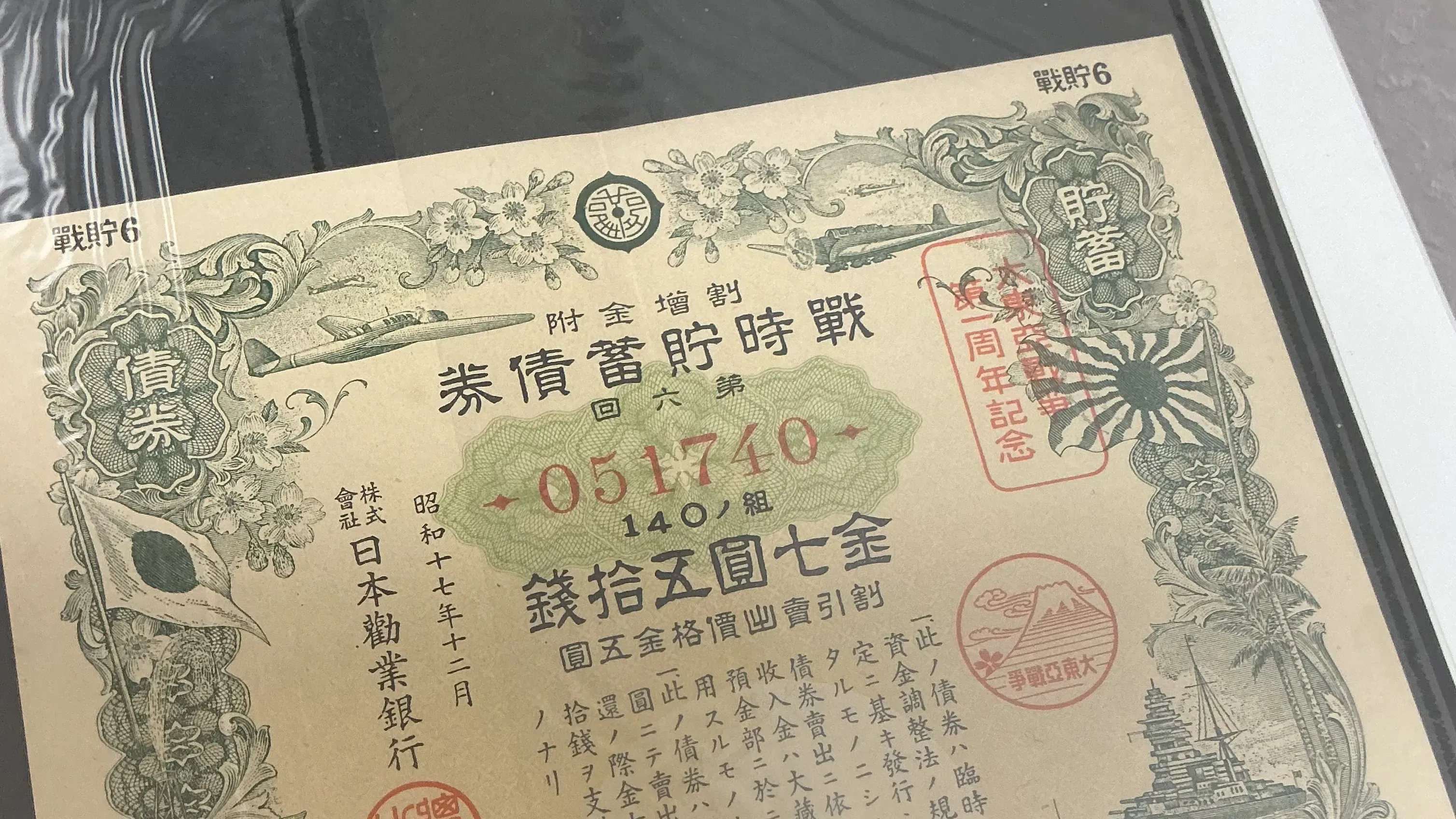
Wrapped neatly in protective plastic sleeves, this stack of eighty-year-old paper sits on the table looking remarkably respectable. Honestly, if it weren’t for the fighter jets, tanks, and Rising Sun flags radiating a strong scent of expired historical embalming fluid, you could easily mistake these for fine miniature prints picked up by a European gentleman at a Left Bank flea market.
You have to hand it to the Empire of Japan; they approached aesthetic design with a rather breathtaking level of morbid precision. The intricate, engraved anti-counterfeiting borders are as delicate as handmade lace. Right at the top, a pair of heavy bombers cruise through the clouds in an elegant formation. In the bottom left, a Type 97 medium tank is rendered so sharply you can see the mud on its treads, while a battleship plows through the waves in the bottom right. In the gaps between these machines of war, the designers very tastefully packed in cherry blossoms and the Hinomaru national symbol.
Yet, despite whatever fanaticism they once carried, these slips of paper—bearing kanji and katakana that read “Wartime Savings Bond” and “Wartime Patriotic Bond”—are now just beautifully preserved trash. Their face values range from 7.50 yen to 15 yen, accompanied by a bunch of postal tokens used to squeeze the loose change out of the working class.
This isn’t just old scrip. This is a perfectly preserved specimen of a state-sponsored financial collapse. Wrapped inside a highly respectable skin, it perfectly illustrates the three-step death march of sovereign credit: starting with grand marketing, moving to moral extortion, and ending in an absolute, cold-blooded rug pull.
There is an old, dark joke in financial history: When a sovereign state starts using the highest level of national aesthetics to market its own credit, it usually means the treasury contains absolutely nothing but fresh air.
Let’s rewind to 1942. At the time, the average Japanese citizen was likely basking in the grand narrative of Pearl Harbor. The front-page headlines were daily exercises in creative writing, boasting about where the Emperor’s flag had been planted next. But behind the curtain, the bureaucrats at the Ministry of Finance were staring at a melting deficit and slipping into a state of highly polite panic. Modern warfare is a brutally expensive meat grinder. It doesn’t run on spiritual energy; it runs on hard cash and oil.
Seeing the foreign reserves and gold bars drying up, these financial elites promptly tore off their serious banker masks and rebranded themselves as the Empire’s top advertising executives.
1. The Art of Psychological Framing
First, they mastered the art of psychological framing. Normal government bonds are dull, dry lists of numbers and clauses; a single glance can cure ten years of insomnia. But these wartime savings bonds were different; they were living military pin-up posters. By packing the paper with tanks, artillery, and warplanes, the state pulled off a brilliant psychological trick:
“My friend, you aren’t buying a sketchy IOU; you are personally ordering a shell for the front lines.”
This aesthetic hypnosis made ordinary citizens feel as if they were standing at the center of global history as they handed over their savings.
But the most exquisite detail was a four-character phrase on the face of the bonds: 「割増金附」. Translated into plain English, that means “Comes with a raffle entry.”
This highlights the most cynical, yet darkly humorous, angle of the marketing machine: the state began actively weaponizing the gambling instincts of the poor. Under strict wartime rationing, the average family couldn’t even get enough rice, and normal savings interest rates couldn’t keep up with inflation. So, the government played along, repackaging a serious sovereign debt instrument as a lottery ticket with the promise of overnight wealth. The jackpots were absurdly high, successfully baiting struggling working-class families into gambling their last grocery money on a state-sponsored roll of the dice.
2. Upgrading to Moral Extortion
Of course, even the best advertising has a shelf life. As the smoke cleared from Midway and Guadalcanal, and the Americans began methodically pushing the front lines back, the black hole in the treasury grew wider. By this point, pretty pictures of planes and imaginary jackpots weren’t enough to convince people who were starving.
And so, the game shifted into its second phase: the state machinery politely flipped the table, upgrading the siphon from “voluntary investment” to “moral extortion.”
At this point, the papers in your hands take on a suffocating tone of administrative coercion. The bonds screaming about lottery fortunes fade away, replaced by “Patriotic War Bonds” stamped with bright red commemorative seals. In fact, many of these bonds quite frankly bore the label “Zero Interest.” If the earlier savings bonds were a capitalist carrot, the Patriotic Bonds were the total death of financial freedom.
The state couldn’t fund a multi-billion yen war just by squeezing big corporations; it had to go retail, down to the penny. Couldn’t afford a large bond? No problem. The Empire very thoughtfully created wartime savings stamps worth just a few yen or even fractions of a yen. Through the vast national postal network, the government hooked the financial vacuum cleaner directly into the pockets of housewives and school children. Kids were told to buy these little stamps with their pocket money, stick them onto a card, and once it was full, it was forcibly converted into a government bond.
Under the shadow of the National Mobilization Law, buying these interest-free patriotic bonds wasn’t a financial choice; it was a mandatory political loyalty test. Your neighbors, your wife’s peers at the neighborhood association, and your boss at work would look at you with deep, concerned eyes and ask: Have you shown your patriotism today? If you refused, the label of “unpatriotic traitor” would be pinned to your chest with pinpoint accuracy. When finance stops being about fair exchange and starts swinging the club of moral duty and administrative threats, sovereign credit becomes nothing more than a bayonet pressed against your ribs.
3. The Ultimate Rug Pull
However, the iron law of financial history remains undefeated: No matter how premium your marketing is, and no matter how precise your extortion schemes are, if you lose the bet, all sovereign credit turns into absolute zero overnight.
Looking at these crisp, beautifully preserved papers on the table today, let us state the coldest conclusion in the calmest tone possible: In the eyes of modern finance and law, their current redemption value is exactly zero.
On August 15, 1945, when Emperor Hirohito’s static-heavy voice crackled through the radio over the ruins of Japan, the sovereign credit of the Empire suffered sudden cardiac arrest. The subsequent wipeout was orderly, and it graciously offered holders a two-part liquidation package:
- The Institutional Wipeout: When the Allied Occupation (GHQ) kicked down the doors of the Ministry of Finance, they issued a cold decree to ensure Japan’s war machine could never be rebuilt: Freeze and void all national debts related to wartime military spending. In plain English, this meant: “The old regime’s IOUs hold no water with the new management.” The papers citizens had hoarded for years became instantly worthless historical corpses.
- The Inflationary Erasure: Second, even if a few small savings accounts managed to survive the legal purge, they were met with a tidal wave of hyperinflation. Post-war Japan was a wasteland of black markets, and prices skyrocketed hundreds of times over in just a few years. That 15-yen bond your grandfather starved himself to buy, hoping it would secure his future, was diluted so badly by inflation that it couldn’t buy a single matchstick or a grain of rice on the black market. The state legally wiped its slate clean through the most invisible method possible, leaving the entire bill of a failed geopolitical gamble to be paid by the everyday people who bought into the grand narrative.
Conclusion: Bizarre Immortality
The darkest humor of history is usually written on its tombstones.
This stack of war poison, which once bankrupt countless families and funded a military nightmare, has crossed eighty years to undergo a bizarre mutation. Stripped of its toxic ideology, it has become a premium “vintage paper collectible” in global antique circles purely because of its high-tier wartime craftsmanship and defensive aesthetic design.
By becoming completely worthless, it managed to achieve historical immortality.
This introductory piece serves as the baseline for our entire series. In the upcoming entries, we are going to put this old paper under a high-powered magnifying glass, strip away its security fibers, and calculate just how rigged the prize payouts from the Ministry of Finance actually were. We don’t tear down this history to mock the dead; we do it to warn the living. The eras change, the PowerPoint buzzwords of sovereign marketing change, and the logos on the bonds change, but the financial logic woven from fanaticism, morality, and credit has never changed in human history.
Always remember: in any era, never bet your hard-earned cash on someone else’s manic obsession with a grand narrative.