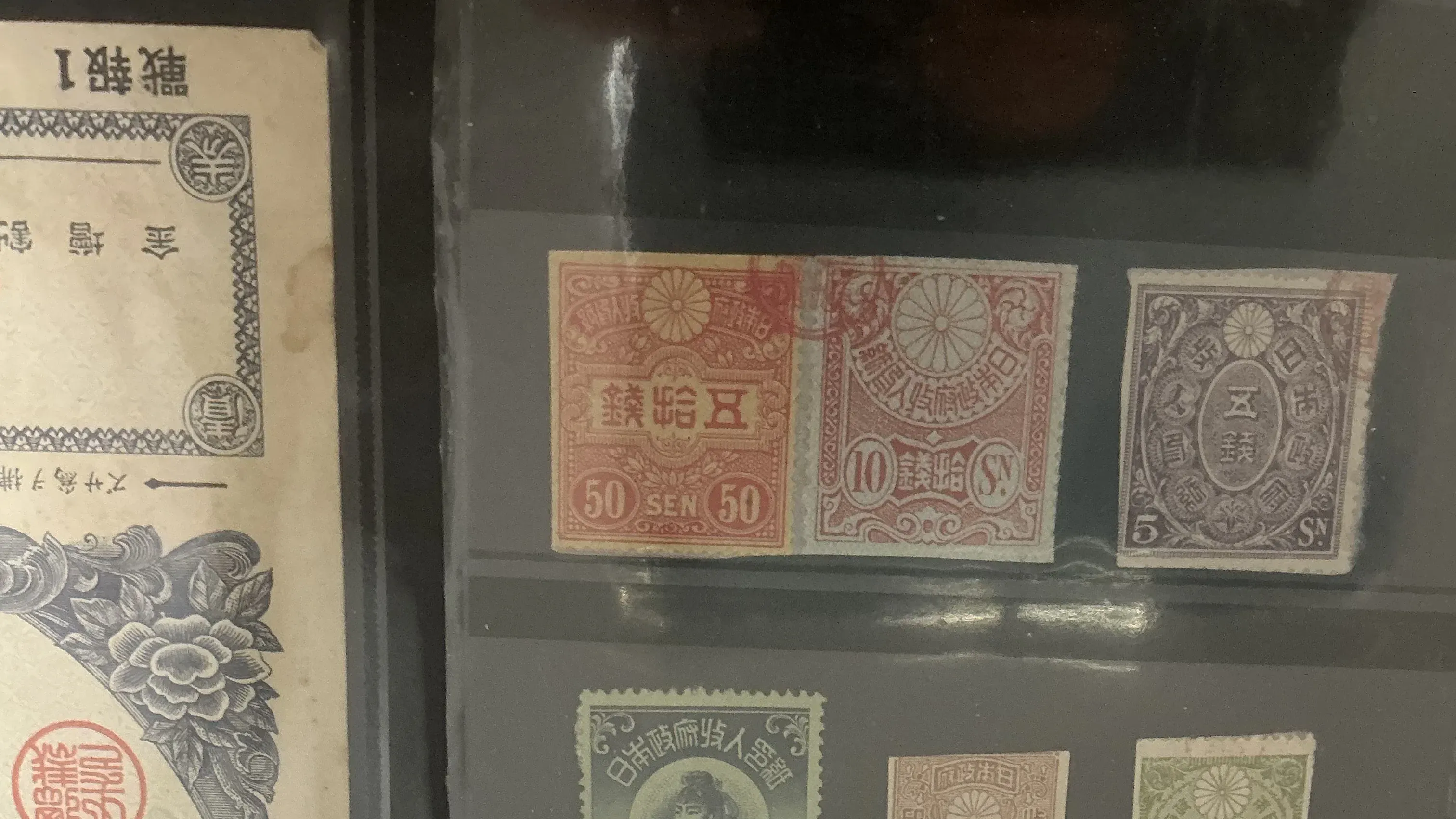
Let’s shift our focus to two alternative physical specimens cataloged in our declassified vault.
The first is a narrow, fragile slip of paper. At the top, it bears the official print of the “Imperial Japanese Post.” Stamped across the middle is a rather aggressive, bold red overprint: Postal Savings Stamp Token, with a face value of a grand total of two yen. The second item is slightly more respectable: a wartime savings bond with a face value of exactly seven yen and fifty sen. In a geopolitical conflict measured in hundreds of millions of yen, these amounts are absurdly tiny. They wouldn’t even cover the cost of a single primer cap for a Type 94 mountain gun on the front lines.
Yet, these exact low-value slips of paper formed the foundation of the most terrifying, nano-scale wealth extraction furnace engineered by the Shōwa state.
The Macro-Liquidity Illusion
Amateurs in macroeconomics always assume that massive war machines run strictly on the giant gold bars of corporate conglomerates, deep foreign reserves, or massive institutional credit lines. But by 1942, that top-tier financial liquidity had already been completely burned through.
The fuel that kept the back half of the Empire’s death march moving came from this loose change. The bureaucrats at the Ministry of Finance didn’t leave a single blind spot in society. They engineered a siphon that worked at a cellular level, pulverizing sovereign debt into microscopic crumbs to scrape the very marrow out of the domestic population.
The Cellular Parasitic Network
The first step in this micro-harvesting strategy was establishing a financial parasitic network that was entirely unavoidable.
You have to give credit where credit is due: the Ministry of Finance, working hand-in-hand with the Ministry of Communications (the postal service), displayed a retail distribution capability that would make a modern e-commerce platform jealous. Realizing that large “Patriotic Bonds” were far beyond the financial reach of the average peasant, the state extended its tentacles into the absolute capillaries of the population: the thousands of tiny rural post offices and primary school classrooms scattered across the country.
The Postal Savings Stamp Token was essentially a micro-investment gateway. The pocket change of a struggling housewife, a poor farmer living hand-to-mouth, or an elementary school kid meant absolutely nothing to a corporate commercial bank. But the state came along with a highly convenient solution: you didn’t need to buy a whole bond today; you just bought these micro-stamps at the post office and stuck them onto a state-issued savings card, exactly like collecting standard postage.
The regime went out of its way to wrap this mundane act in a sacred sense of ritual, calling it “Accumulating Drops to Save the Nation.” Children were organized in classrooms, right under the watchful, encouraging eyes of their teachers, to exchange their pennies for these ink-scented slips of paper. Once a kid’s card was completely packed with stamps, the school or post office forcibly converted it into a proper wartime savings bond featuring illustrations of tanks and battleships.
This was psychological engineering at its finest. By gamifying the network, the state transformed the most economically insignificant individuals into micro-donors to the sovereign credit line. Your two yen couldn’t build a tank, but when millions of children’s pockets and tens of millions of kitchen grocery bags were hooked up to the same vacuum cleaner, the collective flow of low-tier liquidity provided a massive, non-stop river of cash to the military foundries.
Weaponizing the Lottery Mask
If the post office network solved the problem of where to plug in the siphon, the actual financial mechanics of the bonds answered the question of how to make people hand over their money voluntarily.
Take a close look at the seven-yen-fifty-sen savings bond. The real magic trick is written right there on the face in those four characters: Comes with a raffle entry. By the middle of the war, as the shadow of hyperinflation began creeping across the country, any rational citizen knew that lock-up government debt was a suicidal asset allocation. The pathetic interest rates on standard savings accounts couldn’t even keep up with the price of a bundle of firewood on the black market.
So, the financial bureaucrats did something incredibly cynical: They tore off the rational mask of financial contracts and used gambling psychology to re-engineer sovereign debt as mass entertainment completely.
This was a brilliant deployment of lottery psychology against an anxious population. In a closed wartime economy where food was strictly rationed, and American bombs were an everyday threat, financial anxiety was through the roof. The poorer and more desperate people become, the more they look at a “get-rich-quick” option as a form of divine intervention. The state weaponized this perfectly.
They turned these low-value savings bonds into a state-approved lottery. The propaganda told citizens: Spend 7.50 yen today, and you aren’t just serving the Emperor; you are buying a ticket to change your family’s destiny forever. The bonds featured lottery numbers tied to massive jackpots. Winning meant you could theoretically walk away from the daily struggle of the war as a wealthy, celebrated patriot. And if you didn’t win? The fine print gracefully noted that the state would still return a baseline principal of 5 yen at maturity.
It was an exquisite hustle that modern investors can only look at with dark amusement. The state used the grand aura of national duty to hide the reality that the asset’s liquidity was frozen solid and its purchasing power was being quietly turned into vapor by inflation. Driven by lottery hype, ordinary people willingly lined up to hand over their milk and salt money for an astronomical chance at a jackpot. Sovereign credit no longer needed to present a healthy balance sheet; it just needed to run a legal casino for desperate gamblers to secure total domestic liquidity.
Micro-Fuels for the Void
When you look back through the cold lens of history at these tiny pieces of paper, the reality of wartime asset liability becomes crystal clear.
To a state waging a total geopolitical gamble, the micro-savings of the working class were never seen as private assets to be protected. The actuaries at the Ministry of Finance never intended for these two-yen tokens or seven-yen bonds to preserve wealth across generations.
From the second they left the printing press, their only purpose was to act as micro-fuel. The state broke down the granularity of sovereign debt to a cellular level, using the postal infrastructure to merge millions of tiny streams into a massive river of capital, all while using raffle jackpots to keep the crowd hypnotized. The pocket change of schoolkids, the secret savings of housewives, and the emergency reserves of farmers were systematically funneled straight into a destructive macroeconomic void.
By the time the final collapse arrived in 1945, bringing legal voiding and massive inflation, these bonds couldn’t even be redeemed for a bowl of rice. They stand today as a flawless case study in nano-scale financial extraction, leaving behind beautifully preserved, highly collectible pieces of paper that carry a financial value of absolute zero.