If the collapse of sovereign credit is a slow death march, the most terrifying stage isn’t the final wipeout. It is the moment right before the crash, when the state tears off its commercial mask and turns financial contracts into a moral bayonet pressed against the chests of ordinary citizens.
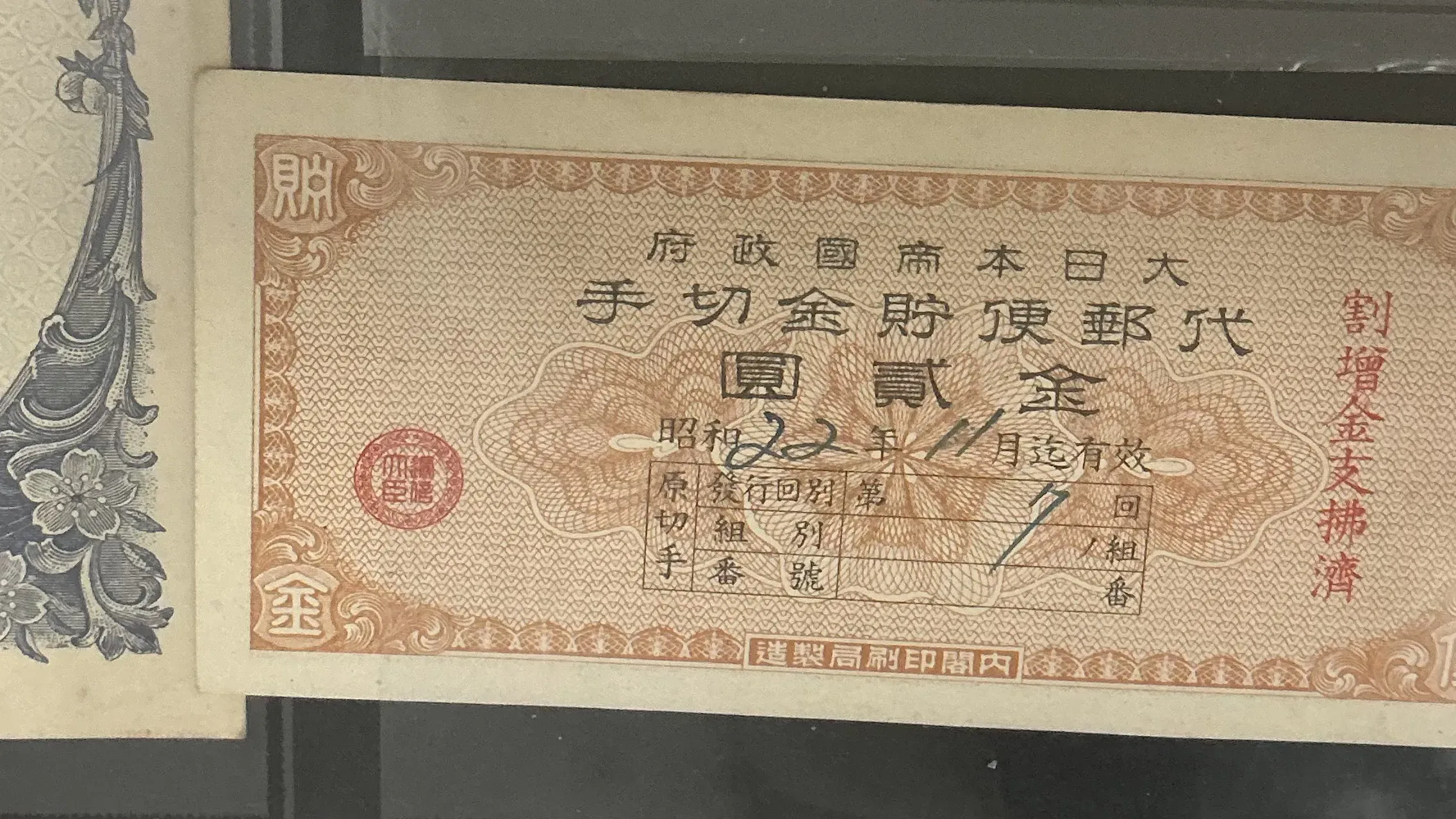
In our declassified vault, two historical paper specimens lie side by side, showing a stark shift in political and financial pressure.
The first is a wartime savings bond featuring the usual lottery prize entry. Its layout still carries a trace of commercial logic. It uses intricate anti-counterfeit patterns and graphics of warships and tanks to grab attention. Even though the state was already digging deep into the pockets of the working class at this stage, it still respected the basic rule of a transaction: you give the state liquidity, and the state gives you a shot at striking it rich. It was a twisted exchange, but an exchange nonetheless.
Now look at the second specimen: a special wartime bond issued to mark the first anniversary of the Greater East Asia War.
All the flashy colors and lottery promises are gone. Instead, you see a cold, monochrome design designed by strict bureaucrats. Stamped boldly across the face is a bright red official seal. The word “Savings” has been replaced by “Patriotism” and “State Devotion.”
This transition marks a dark evolution in macroeconomic history. It shows the exact moment when commercial contracts died, and raw administrative force took over personal wealth.
The Death of Returns
To understand this shift, we must look at how the core pillar of finance vanished: interest.
In standard economics, credit is simply the pricing of risk. When a government issues bonds, it borrows money as a debtor and pays interest to compensate investors for inflation and locked-up liquidity. Even in the early stages of war, financial bureaucrats had to play by these rules. As the war dragged on and risks grew, the state had to offer higher nominal interest rates or high-stakes lotteries to combat the public’s natural fear of hyperinflation.
But by late 1942, as the Pacific War dragged into a brutal war of attrition, the empire’s financial ledger fell apart.
The military machine devoured steel, rubber, and oil faster than money could be printed or raised through normal markets. With black-market prices skyrocketing daily, paying real interest rates that outpaced inflation would have bankrupted the Treasury in weeks.
So, the Ministry of Finance made a cynical pivot: if they couldn’t afford to pay interest, they simply wouldn’t.
On these newer wartime bonds, the financial contract was completely dismantled. The state stopped offering competitive yields or tempting lottery prizes. The coupon rates were forced down to pathetic, insulting levels, and some tranches were issued with zero interest.
It was an absurdity in financial history: liquidity was frozen indefinitely, real returns were guaranteed to be negative, and buying a bond meant watching your wealth evaporate in a wave of inflation.
The Arrival of the Moral Bayonet
How did the government keep this machine running once the financial incentives were gone? Why did ordinary people keep pouring their hard-earned money into this macroeconomic void?
The answer is simple: the arrival of the moral bayonet.
When commercial logic died, and sovereign credit could no longer attract capital naturally, the state stepped in with administrative monopoly and violent coercion, turning financial choice into a forced loyalty test.
The legal backbone for this shift was the National Mobilization Law. This law gave the state unlimited access to the lives and property of its citizens. At the same time, the banks tasked with selling these bonds changed overnight.
In peacetime, a bank is a credit intermediary that uses friendly service and interest rates to attract depositors. Under the wartime regime, however, these banks became direct extensions of state coercion.
Buying a bond was no longer a personal investment choice. It became a mandatory, high-stakes political audit.
High-Pressure Extortion
The government pushed this moral extortion deep into the daily lives of the population. In cities, local wartime neighborhood associations went door-to-door with official registry books. The amount each household had to buy was calculated behind closed doors by bureaucrats, based on a family’s meager wages or ration cards, and deducted automatically.
This was high-pressure moral blackmail carried out at the neighborhood level. In a tightly controlled, conformist society filled with surveillance and informants, refusing to buy a bond wasn’t just an economic decision it was social suicide.
If someone said “no” to a bond stamped with the red official seal, or showed any hesitation about sacrificing their savings, they were instantly labeled unpatriotic. In that fanatical environment, that label meant losing access to scarce food rations, seeing your children shunned at school, and inviting visits from the military police.
Buying bonds became a forced tribute to the state machine. Refusing to buy was treated as treason and a betrayal of the soldiers dying on the front lines. Financial freedom and property rights were completely crushed under this moral club.
Private wealth stood no chance against this state-sponsored extortion. Emergency savings kept in kitchen drawers for sick children, and retirement funds built through years of hard labor, were systematically handed over for pieces of paper whose purchasing power dropped every single day.
The Execution Ground of Wealth
The most dangerous moment for sovereign credit isn’t when a government admits it is broke and defaults. It is when the state, running on empty but determined to keep its war machine moving, abandons fair exchange entirely and turns to moral extortion to seize domestic liquidity by force.
Once the boundary between finance and state coercion is erased, the market becomes a quiet execution ground for personal wealth. This official anniversary bond is a perfect specimen of sovereign credit mutating from an investment tool into a weapon of the state.
It serves as a cold warning to modern investors: when an issuer stops talking about balance sheets, yields, and contracts, and instead uses heavy moral language to force you to back its credit, the underlying machine has spun out of control.
These historical papers, now completely worthless, still carry the heavy scent of state coercion. They are not proofs of wealth, but the physical remains of an administrative bayonet that was once pressed against the chests of ordinary people.