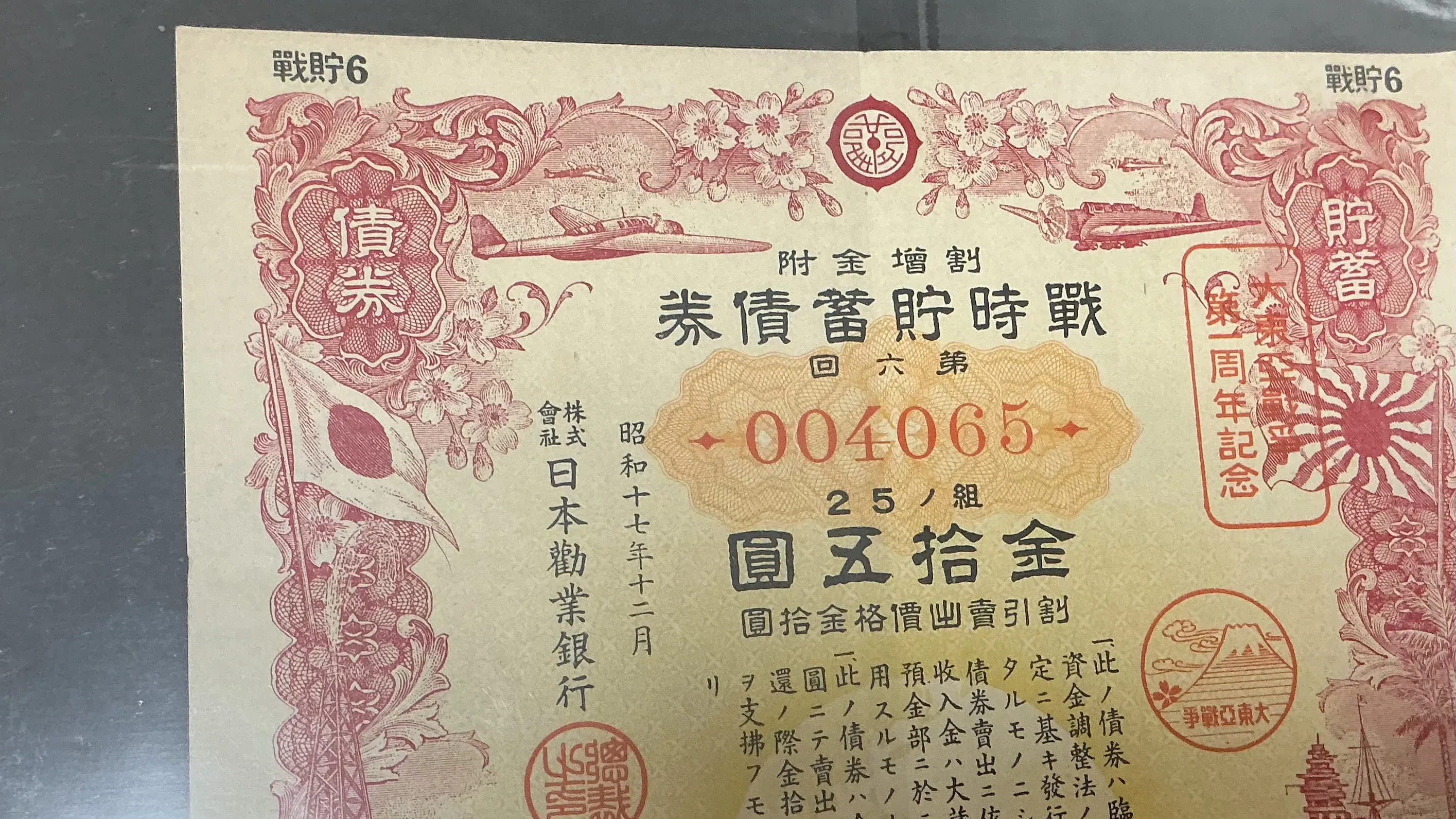
When we gather this stack of wartime bonds and savings certificates preserved nearly perfectly for over eighty years and feel the geometric security patterns and bold red seals under our fingers, the cold weight of financial history sets in.
In today’s collectibles market, these old papers are highly prized for their historical significance and the dark aesthetic of a past geopolitical disaster. But if we strip away the antique value and place them on the harsh chopping block of macroeconomic reality, we must face an absolute truth: no matter how solemn the promises printed on the face, or how enticing the lottery rates used to draw people in, the legal value of this entire stack of debt today is exactly zero.
This was not a standard investment failure. It was a calculated murder of sovereign credit orchestrated by geopolitical shifts and executed by state machinery. It serves as a textbook dissection of how private wealth can be legally wiped clean off the books.
The Erasure of the System
To understand the death spiral of sovereign credit, we must look at the first blunt tool used during a regime change: institutional erasure.
People often assume that a “state” is a continuous entity. The common belief is that even if a government changes or loses a war, it will eventually settle its old debts on some pro-rata basis. However, the arrival of General MacArthur and the Supreme Commander for the Allied Powers (SCAP) in August 1945 completely shattered that illusion for the Japanese public.
When the surrender was signed, the wartime economic machine collapsed overnight. The occupying forces did not view the mountain of outstanding wartime bonds and military debts as legitimate civilian assets to be protected. To them, these papers were financial toxic waste feeding the roots of militarism, a ledger that needed immediate purging.
The new administration issued a swift decree freezing and completely abolishing all military debts and special wartime bonds issued by the previous regime. The newly formed cabinet, acting under direct pressure, had no room to negotiate.
Overnight, the legal framework shifted. The savings bonds accumulated by ordinary housewives and school children became illegal tokens of a defunct regime. The new government simply dissolved its obligations as a debtor. Citizens held physically perfect bonds that had been completely formatted out of existence by the legal system.
Death by Money Printing
Institutional erasure took care of the major military bonds, but the new administration initially left some low-denomination savings certificates tied to standard postal accounts intact to prevent widespread civil unrest. Yet, this did not mean citizens got their real wealth back. The state still held a much quieter, deadlier financial weapon: hyperinflation.
If your assets survived direct legal cancellation, the invisible hand of inflation caught you at the finish line.
By late 1945, the country’s macroeconomic ledger was broken. Production had ceased, goods were virtually non-existent, and the massive amounts of paper currency printed to fund wartime manufacturing flooded the black market. A textbook hyperinflation took hold.
We can trace this destruction through a simple example. Early in the war, a savings bond with a face value of 15 yen or 7.50 yen represented a significant sum for an ordinary working family. In 1941, the real purchasing power of that bond could support a household for months. In rural areas, it could match the value of a healthy plow ox or a fertile plot of farmland. It was the ultimate safe-haven asset against the unknown.
By the end of 1945, the face value printed on the paper remained exactly the same, but the purchasing power had vanished. As black-market prices surged hundreds of times over, the real value of the currency evaporated. The 15 yen that once could buy an ox or a plot of land could now barely buy a single grain of rice or a watered-down bowl of barley porridge on a ruined Tokyo street corner.
The Ultimate Sovereign Eraser
This is the cleanest form of legal theft. The state doesn’t need to send police to confiscate your physical wealth, nor does it need to issue an official decree abolishing the asset. It simply lets the printing presses run until the currency’s purchasing power is diluted ten-thousand-fold.
On paper, the banks remain polite. When your bond matures, they will hand you the exact number of coins or notes promised on the face. But the moment you step outside and realize those notes can’t even buy a piece of scrap paper, the reality sets in: your life savings were quietly liquidated by the system.
Hyperinflation is the ultimate eraser for a bankrupt sovereign machine. It keeps the government’s nominal accounting books perfectly balanced while completely wiping out the survival capital of the population.
The Fallout of Geopolitical Gambles
Looking at these crisp, unfolded wartime bonds in our archive, the historical irony is clear. The better they were preserved, the more they mock the absolute faith their original owners placed in sovereign credit.
Ordinary investors easily fall into a false sense of security provided by grand national narratives. They assume that as long as the state apparatus stands and the military is active, a government IOU is the safest asset available, a store of wealth that can outlast generations.
But the cold records of financial history tell a different story: when a sovereign entity loses its geopolitical gamble, its credit turns to ash. In the grand machine of global politics, there is no absolute safety. The defensive assets you buy during a period of national hysteria are never viewed by the issuer as wealth to be protected. They are merely the first chips sacrificed on the table to pay for the state’s survival.
When the avalanche hits, the first survival mechanism of a broken sovereign credit is always to wipe the ledger clean, and the individual investor is always the first number to be erased.