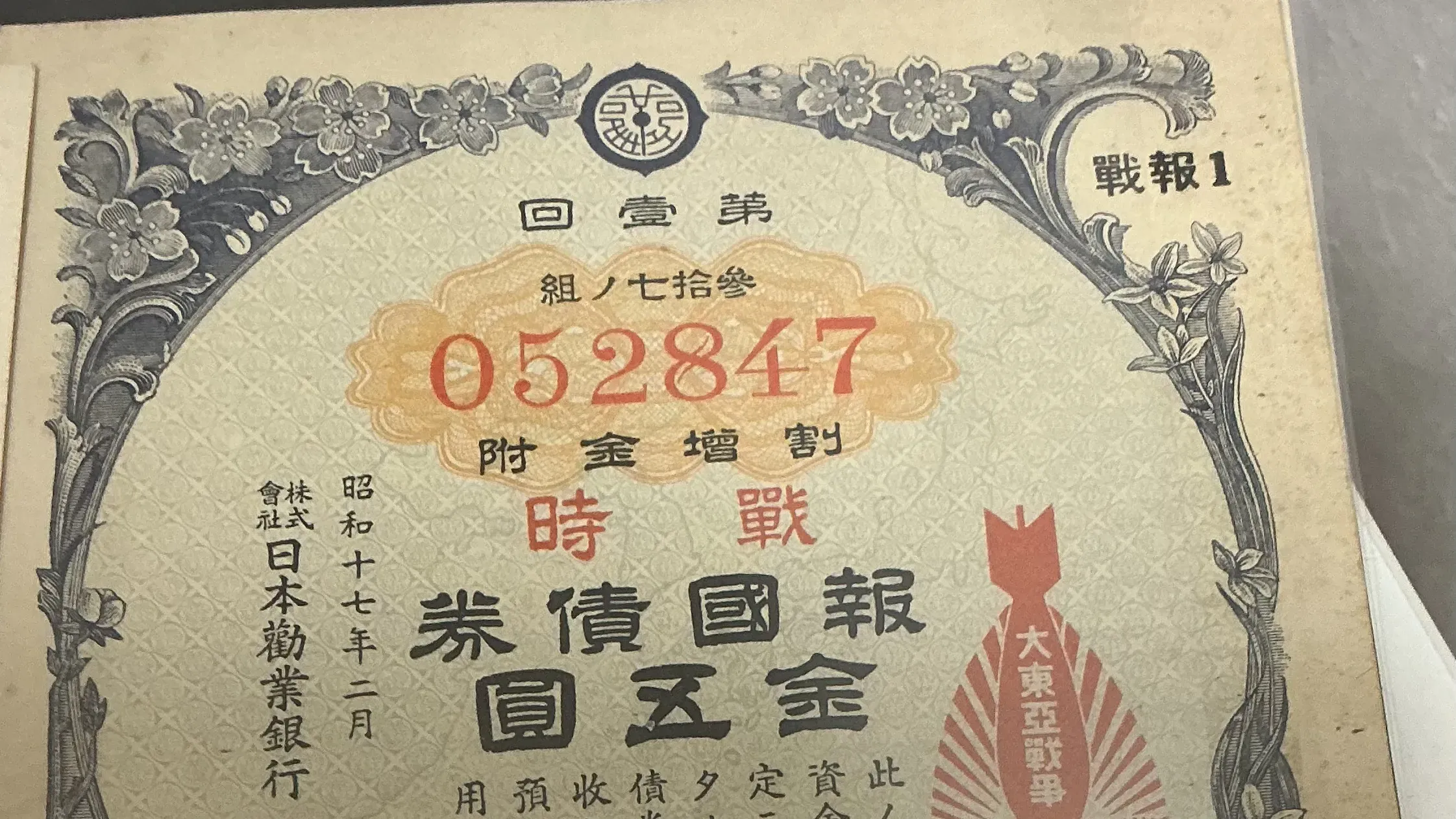
When you look closely at these fragile pieces of paper again, a strange and powerful visual contrast takes over.
If you lay them flat on a desk and look through a magnifying glass under a cold light, the first thing you notice isn’t the blood or cruelty of war. Instead, you see the peak design aesthetics of the industrial age. The printing uses incredibly detailed engraving. Fine lines intertwine perfectly to create highly confusing anti-counterfeit patterns. In the faded ink, the snowline of Mount Fuji subtly appears, iconic cherry blossom petals sit quietly on the margins, and aged postal savings stamps bear bold official seals. All these symbols blend, carrying a quiet, classic beauty born from disaster.
Looking at this scene, you can’t help but marvel at the unpredictability of fate and the dark irony of history. After drifting through more than eighty years of time, these old papers have completed the most ironic and unbelievable life cycle in financial history.
Decades ago, they were absolute wartime poison. Behind every single two-yen savings stamp was the milk and bread stolen from a working-class family. Every seven-yen-fifty-sen lottery bond was a financial trap set for desperate, low-income gamblers. And those patriotic bonds stamped with red seals were moral bayonets pressed against people’s chests, forcing them to surrender their livelihoods. The state machine broke its massive debt down into microscopic crumbs, pushing them into the hands of school children, housewives, and poor farmers to extract the last drops of domestic liquidity for the front lines. They were the ultimate tools of a state-sponsored financial scam, bankrupting countless people to feed a war machine.
Wiping Out the Toxicity
However, after going through the legal cancellations of 1945 and the ruthless destruction of hyperinflation, the purchasing power, the promises, and the legal value of these papers were completely stripped away. Their financial worth became absolute zero.
Yet, a bizarre twist occurred. As the poison of war was washed away by the tides of time, and the regime that printed them turned to ash, these dead financial assets found an opposite fate in the modern collectibles market.
Today, in top antique auctions and historical document exhibitions in New York, London, or Tokyo, these well-preserved wartime bonds are displayed in expensive, UV-protected acrylic frames. They have become highly sought-after art pieces and historical artifacts, fiercely bid on by collectors and scholars worldwide. No bank today will exchange that original two-yen or seven-yen face value for a single grain of rice, yet the trading price of the paper itself has jumped hundreds or thousands of times over.
This is the ultimate irony history leaves behind: when a financial contract turns into a geopolitical disaster, it bankrupted individuals financially, but it achieved immortality as art and historical evidence. It mutated from a cold tool of extortion into a unique historical artifact independent of sovereign credit. Collectors chase these papers not because they expect future cash flows, but because they are physical cross-sections of a fanatical era. The faded ink holds the real, micro-level breath of a nation marching toward its doom.
The Lasting Warning
Standing on top of these financial ruins to look at the big picture, we can see that while these crisp wartime papers faced a brutal wipeout in economics, their value as historical testaments is beyond measure. With their worthless physical bodies, they send a chilling warning across eighty years to every modern investor.
Human memory is short and forgetful. Whenever a macroeconomic cycle reaches its end, and geopolitical tensions hit a boiling point, financial bureaucrats in grand office buildings will always dust off the old playbook. They will wrap the same old theft in fresh, dazzling terms. They will create new financial derivatives, promise high virtual returns, or use modern media to wave moral clubs, forcing individuals to back the massive ambitions of the state machine.
Yesterday’s tiny savings stamps are today’s micro-digital investments. The wartime bonds with lottery tricks are now standard state-run welfare lotteries. And the moral coercion used decades ago has only become faster and more suffocating under the megaphone of the modern internet.
The Unchanging Machine
Times change, technology evolves, and the marketing presentations of sovereign entities get sleeker, but the underlying gears of the financial machine never change. It is always greedily searching for unprotected private liquidity, using grand narratives as bait to trick or force ordinary people into giving up their survival capital.
When you feel your blood pumping over a massive national narrative, and you believe the government IOU or the trendy safe-haven asset in your hands will help you survive the storm, take another look at these old wartime papers.
Look at the fine engraved lines, look at the bright red seal of state devotion, and tell yourself with absolute clarity: in the face of massive historical shifts, your assets are never viewed by the house as wealth to be protected. They are merely chips to be sacrificed on the table, numbers to be erased from the ledger whenever the state needs to balance its books.
Never surrender your entire life and soul to a fanatical, grand narrative. When the avalanche hits, and the building collapses, those grand stories vanish in a second. All that will be left on the ruins of history are silent specimens like these old paper assets whose value was instantly wiped out, left only for future generations to look at with cold detachment.
History doesn’t repeat itself, but it certainly rhymes.